Are Hackathons a Waste of Time?
Inspired by some thoughts and conversation with friends
🚩 A Red Flag
Over the summer, the Hack the North team released an article titled “Are Hackathons Dying?”. This was a HUGE red flag since, for those who don’t know, HTN is the largest hackathon in Canada, and a hackathon, like TreeHacks and CalHacks, that drives a lot of attention from hackers.
As someone who has been to 20 hackathons and used to be deeply engrained in the space, I wanted write down my thoughts on this.
The article that Jasmine Jiang and Ian Korovinsky put together highlight the main pain points of my opinion on hackathons:
- Hackers are keeping to themselves
- People are becoming more prize-driven than purpose-driven
- Creativity is declining
- The availability of hackathon guides have caused hackers to becoming more formulaic in their projects to optimize for wins
But, I want to introduce a new argument point: hackathons are a complete waste of time for seasoned builders.
📊 Economics
If you are not familiar with The Law of Diminishing Returns, there is the definition from Investopedia:
The law of diminishing marginal returns is an economic concept that explains how, beyond a certain point, increasing one input while keeping others constant will lead to progressively smaller gains in output.
Now, let’s apply this to attending hackathons.
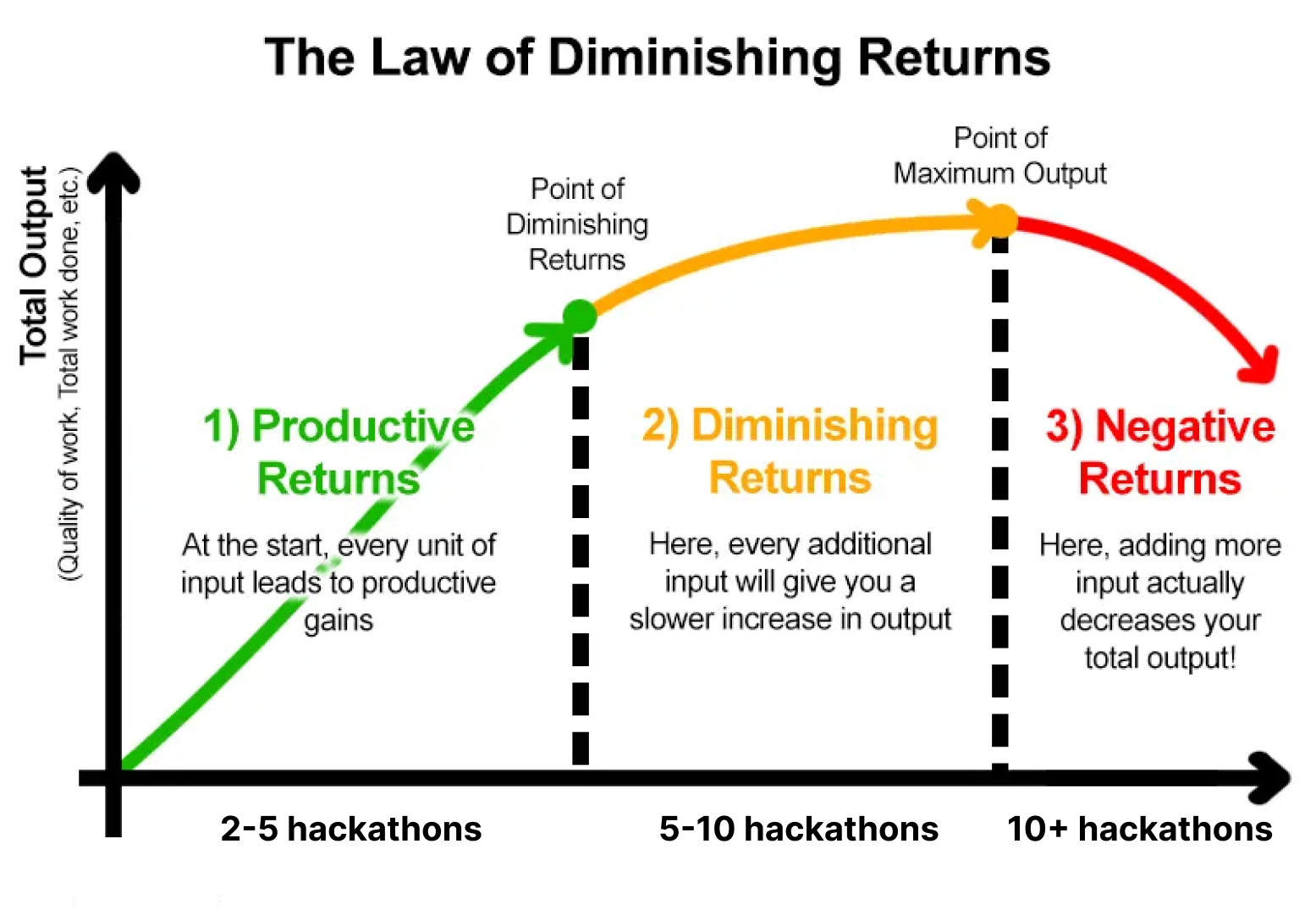
Disclaimer: the amounts here have been chosen arbitrarily by me and my opinions
My argument that the law of diminishing returns applies to hackathons goes is related to the purpose why you SHOULD go to a hackathon in the first place: to learn.
Hacking together something in a weekend is not a suitable environment for long term learning. While winning at these hackathons may provide some good prizes like money, swag, and tech like monitors, speakers, etc., you could have instead spent that time trying to deeply learn something and even buying these prizes with your own money.
🤔 A New Perspective + Counterargument
This blog post isn’t to say that no one should go to hackathons anymore. It’s just that it comes to a point where, if you care about your career growth as a student, you should stop going to them.
Argument
I am aware that there is an argument against this which is that going to these hackathons have helped people land jobs, and that’s good!
Counterargument
I think this is entirely survivorship bias. The clout and attention that you can get from these hackathons to help further your personal brand is good, but it’s not enough. Eventually, you’ll need to prove that you’re technical.
I still suggest though that beginner programmers should attend these hackathons as it will open their eyes to the world of what can be possibly made. It will serve as a jumpstart to teach you how to build things. However, once you learn how to build things, you should just work on projects in your own time and not in the constraint of one weekend. This will allow you to become more deeply technical about a subject instead of just hacking together another AI powered CRUD app.
So, go make something people want.

Written with ❤️ by Krayon
Follow me: x.com/krayon